Quick Summary - Advanced technology solutions are redefining project management from static oversight to dynamic intelligence. Integrated ecosystems combining automation, cloud collaboration, analytics, and predictive intelligence deliver measurable results—42% higher completion efficiency and 35% fewer resource conflicts (2024 global research). These solutions transform scattered data into foresight, enabling early-risk detection, resource alignment, and evidence-based governance.
What Really Changes When You Apply Advanced Technology Solutions in Project Management?
Project management has reached its inflection point. 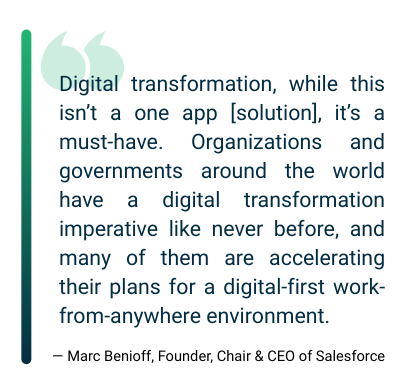
Market volatility, hybrid work, and rising client expectations for transparency have exposed the limits of manual reporting and disconnected tools. Spreadsheets can track—but not predict. Dashboards can show status—but rarely context
Advanced technology solutions integrated ecosystems that blend cloud collaboration, automation, and predictive analytics are what leaders are investing in to deliver both speed and foresight
The data is compelling. A PMI global study found that while only 21% of organizations use AI regularly in projects, 82% expect it to reshape delivery within five years.
A separate peer-reviewed study of 150 companies showed that digital integration increases completion efficiency by 42% and reduces resource conflicts by 35%
These gains mark the shift from project tracking to predictive orchestration—where insights arrive early enough to change outcomes.
The following sections explain how advanced technology solutions build this capability, what architectures sustain it, and how predictive project intelligence transforms data into confident decision-making
According to McKinsey and Runn research, the reality is less than 1% of IT projects achieve all success criteria. The infographic below captures the scale of inefficiency and why predictive intelligence, data-driven solutions can no longer be optional.
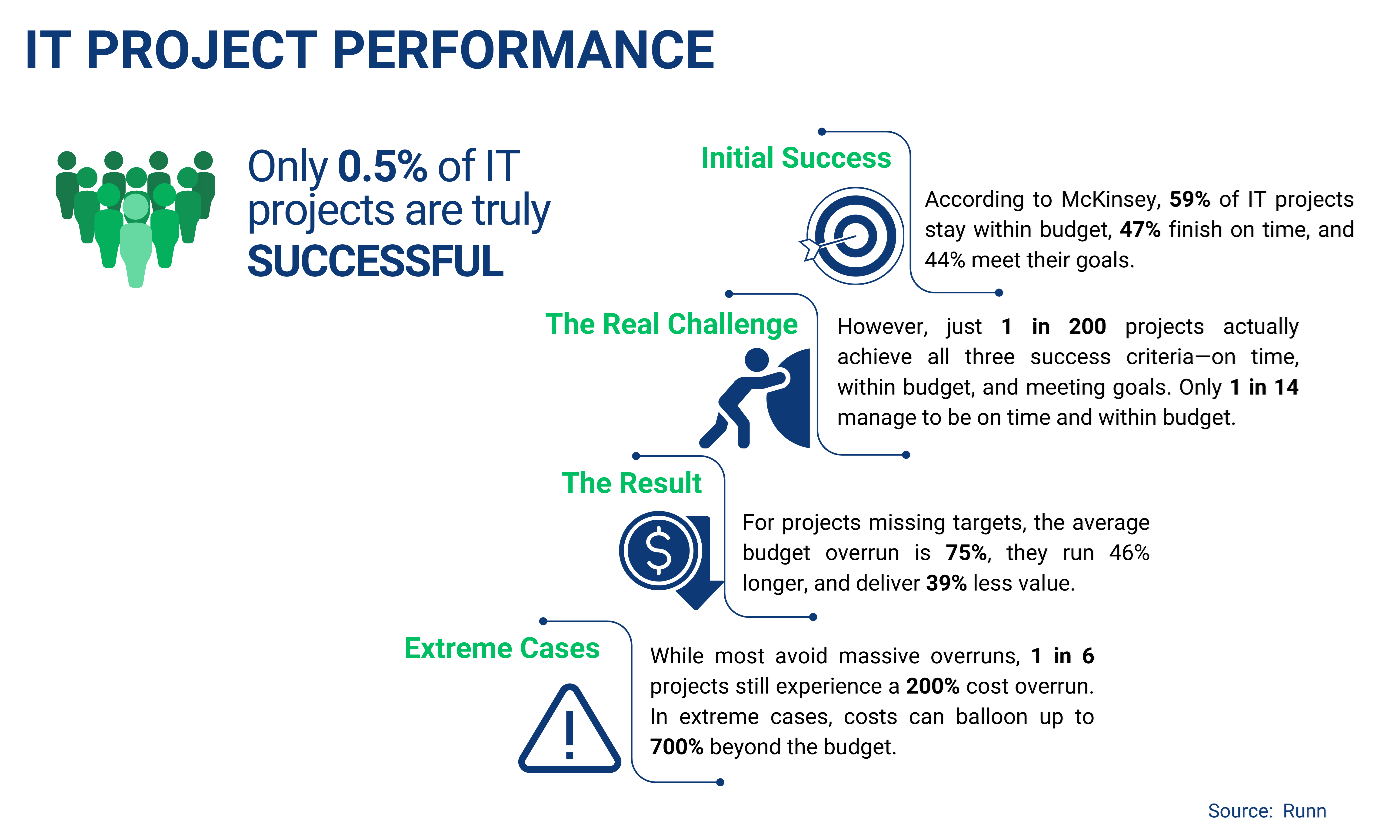
Infographic showing key stages and failure points in IT project performance.
Why “advanced technology solutions” (not tools) is the right lens
Think in systems, not silos
An advanced technology solution is a connected capability—not a point tool. It unifies:
- Cloud collaboration - A single source of truth with permissions and anywhere access
- Automation - Recurring updates, checklists, report assembly, and task routing
- Analytics - Dashboards, drilldowns, and trendlines for real-time KPI health
- Predictive intelligence - Risk forecasts, “next-best actions,” and sentiment signals
When these layers work together, project management evolves from after-the-fact reporting to proactive intervention
Where predictive intelligence fits—without overshadowing the core
Predictive intelligence doesn’t replace core platforms—it amplifies them
It scans history and live signals to identify early risks, estimate variance against baselines, and surface shifts in stakeholder sentiment—long before they manifest as delays.
It converts information into intelligence and project visibility into predictive agility
Advanced Technology Solutions: Definitions, Dimensions & Architecture
In modern project management, advanced technology solutions combine systems, data, and intelligence to create faster, smarter, and more reliable outcomes
These aren’t just tools—they’re connected ecosystems built on four foundational pillars:
- Unified Work Platform (Cloud-First) - Centralizes plans, tasks, files, and discussions in one secure, real-time workspace
- Automation Services - Handles repetitive activities like status updates and roll-ups so project managers can focus on strategy
- Analytics & Visualization - Translates complex project data into dashboards that highlight performance and trends
- Predictive Intelligence - Uses data models to forecast risks, optimize effort, and flag early warning signals
Together, these pillars unlock speed, and scale—the three drivers of projects that finish on time, on budget, and on value
The benefits of embracing advanced technology solutions go far beyond efficiency—they redefine how projects are planned, tracked, and delivered, as shown below
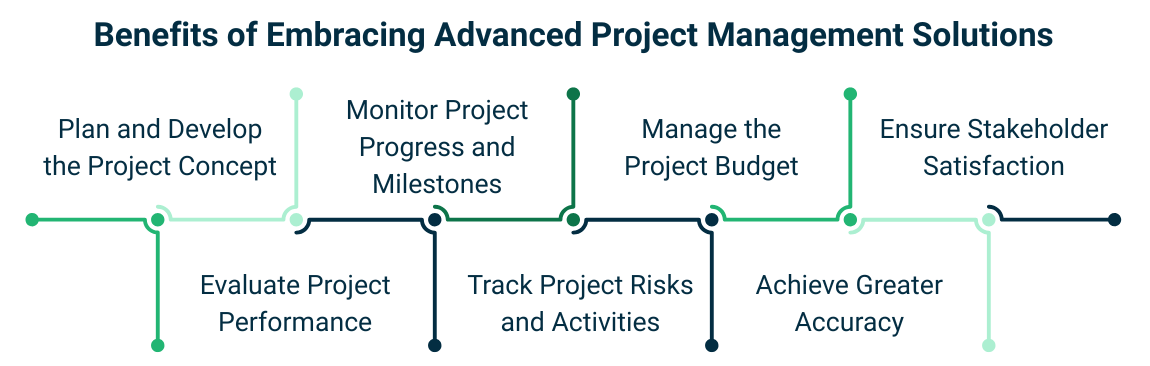
How to Measure Project Maturity with Advanced Tech
To build the right foundation, assess your systems across five critical dimensions:
- Visibility - Can leaders and PMs see end-to-end progress, bottlenecks, and constraints in real time?
- Automation - How many manual steps could be eliminated to reduce errors and save time?
- Predictive Depth - Do your systems forecast likely delays or cost overruns before they happen?
- Integration - Are your tools connected to ERP, HRIS, DevOps, and CRM systems for complete decision context?
- Adoption & Usability - Do teams actually use the technology daily—and find it intuitive?
A 2024 SEAHI peer-reviewed study found that organizations using integrated tools achieved a 42% rise in completion efficiency and substantial reductions in documentation errors and budget conflicts
The takeaway: a connected system outperforms any single tool
A Practical View of the Architecture
A well-designed advanced technology solution consists of five tightly integrated layers that keep every process, decision, and insight aligned:
- Data Intake & Normalization – Collects and standardizes data from schedules, timesheets, costs, and feedback loops
- Analytics & Machine Learning Engine – Establishes baselines, detects deviation, and recommends early interventions
- Workflow & Automation Layer – Automates alerts, approvals, and updates—freeing teams from repetitive work
- Experience Layer – Provides tailored dashboards for PMs, portfolio leaders, and executives
- Governance & Security Layer – Manages permissions, compliance, and data protection
Modern Cloud-native, AI-enabled project management tools can build and scale this architecture using existing data.
If you want to see how a predictive-intelligence layer enhances your current setup, request a TrueProject demo. Experience how early-risk signals and sentiment insights transform into foresight you can act on.
Evidence That It Works
A recent 2024 study confirmed that organizations using integrated digital ecosystems saw:
- 42% improvement in project completion efficiency
- Fewer documentation errors.
- Significant reductions in budget overruns
With architecture and benchmarks in place, the next section explores how to apply advanced technology solutions effectively—from defining outcomes and piloting adoption to scaling predictive intelligence across your enterprise
5 Smart Ways to Apply Advanced Technology Solutions in Project Management
Having established what advanced technology solutions are and how their architecture works, the next question is practical: how do you apply them effectively to achieve measurable gains in project delivery?
Across industries, five proven approaches c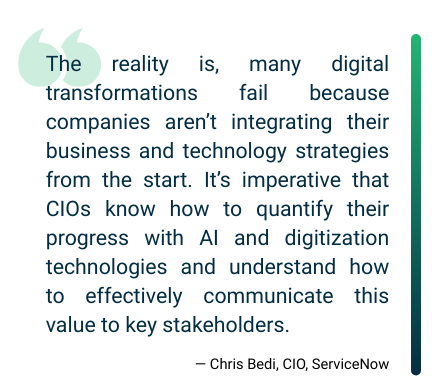 onsistently separate successful adopters from those that struggle
1. Define Clear Business Outcomes Before Deployment
Technology should serve strategy—not the other way around
Start by defining what “better” means for your organization: faster delivery, tighter cost control, higher stakeholder satisfaction, or improved compliance. Then translate those goals into measurable KPIs and align your technology roadmap accordingly
This clarity prevents tool sprawl and ensures every implementation drives tangible business results, not vague transformation goals
2. Unify Your Project Ecosystem with Cloud-Based Platforms
Fragmented tools are the enemy of insight
Consolidate workflows, documentation, and communication into a secure cloud environment that serves as a single source of truth. Integrated ecosystems—combining collaboration, task management, and analytics—enable real-time visibility across teams and geographies
The SEAHI (2024) study found that organizations using integrated cloud platforms achieved a 47% improvement in collaboration efficiency and 38% fewer documentation errors—proving that ecosystem unification directly impacts performance
3. Automate Repetitive Workflows to Free Strategic Capacity
Repetitive administrative work—status updates, scheduling, and report compilation—consumes valuable bandwidth
Automation handles these recurring tasks seamlessly, using workflow bots, triggered alerts, and automated roll-ups to keep information flowing without manual effort
The same SEAHI study reported a 43% reduction in administrative overhead and a 39% drop in coordination costs through automation.
With manual work reduced, teams can focus on strategic decision-making, innovation, and stakeholder engagement
4. Layer Predictive Intelligence for Foresight and Agility
Automation brings efficiency. Predictive intelligence brings foresight
By overlaying AI and machine-learning models on project data, you gain early warnings on schedule risk, resource strain, and stakeholder sentiment. This layer converts static dashboards into proactive decision engines—highlighting what’s likely to happen next and what to do about it
Experience predictive intelligence in action—see how TrueProject turns your data into early-risk alerts and actionable foresight.
5. Measure, Learn, and Refine Continuously
Digital transformation isn’t “one and done.”
Track both leading and lagging indicators—schedule variance, decision-response time, automation hours saved, and predictive accuracy. Use those insights to fine-tune processes, retrain models, and expand successful use cases
Organizations that institutionalize measurement loops see sustained improvement.
The SEAHI data revealed a 52% increase in strategic project alignment once continuous learning became standard practice
By treating measurement as a learning cycle, you build a culture of adaptive intelligence—where technology evolves alongside your business
Together, these five strategies form a blueprint for success. They convert vision into operational traction, ensuring technology becomes a living, learning system rather than a static investment
According to global research, organizations that apply these principles report the following performance improvements
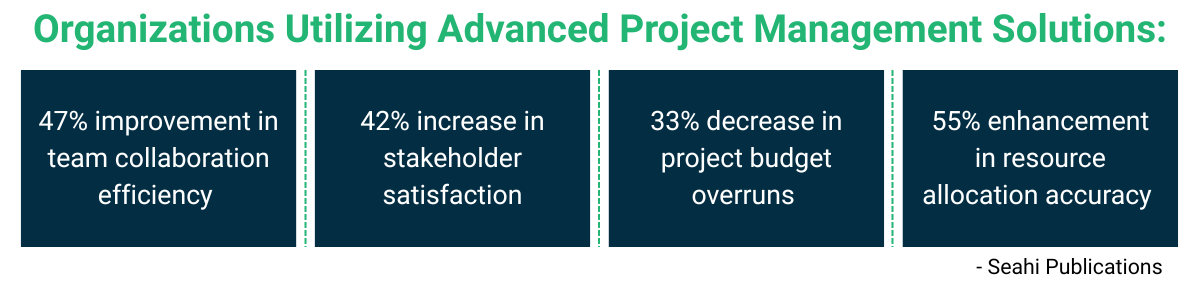
Of course, even the smartest strategies face obstacles. The next section examines the challenges, guardrails, and cultural factors that determine whether your technology transformation accelerates—or stalls
Challenges, Guardrails & Cultural Barriers in Adopting Advanced Technology Solutions
The common friction points you must anticipate
Even with strong business cases, adoption often stumbles on three fronts:
Data fragmentation, skill gaps, and cultural inertia
- Data quality - Disconnected spreadsheets and unstructured updates undermine analytics accuracy. A cross-industry study shows that 65% of organisations cited integration complexity as a top challenge
- Skill gaps - Nearly 30% of project professionals report feeling unprepared to apply AI or data tools in daily workflows
- Change fatigue - Teams see “one more platform” rather than strategic enablement, leading to disengagement and underuse
Make change management a core workstream—anchored in training, reinforcement, and recognition
Guardrails that sustain project progress
- Transparent purpose - Frame technology as augmentation, not replacement
- Explainable intelligence - Ensure predictive models display why a risk was flagged—clarity drives trust
- Ethical-use policies - Protect stakeholder data and routinely bias-test models
- Incremental rollout - Validate success in stages and expand only when KPIs prove value
- Continuous learning loop - Gather feedback, update algorithms, and refresh dashboards regularly
Research by Davidson & Lee (2023) found that transparency and phased adoption reduced risk-related project failures by 40%
Culture - the hidden accelerator or brake
Culture determines whether transformation thrives or stalls
In a three-year global study tracking 500 organizations, teams with structured change-management plans achieved a 49% boost in cross-functional productivity. Those without plateaued within months
Treat change management as a workstream, not a workshop—complete with deliverables, training, reinforcement, and recognition. If adoption feels stuck or resistance grows, schedule a discussion with a TrueProject advisor.
Design a rollout framework that earns user confidence and executive sponsorship
Metrics, Benchmarks & Success Indicators
Measurement is what turns transformation into evidence
To make technology adoption meaningful, link metrics to both operational efficiency and strategic impact
What to measure—and why it matters
Link measurement to both operational efficiency and strategic impact.
| Metric Type | Example Metric | Insight Gained |
|---|---|---|
| Outcome (Lagging) | On-time delivery %, budget variance, resource utilization % | Validates ROI |
| Leading (Predictive) | % of alerts acted upon, time-to-decision, automation hours saved | Indicates agility |
| Adoption | Active-user ratio, report-view frequency | Gauges cultural uptake |
According to the 2024 SEAHI study, organizations that replaced manual methods with integrated systems saw:
- 35% shorter project completion times
- 33% fewer budget overruns
- 47% better collaboration efficiency
Benchmarks for a mature setup
Aim for these within the first year post-implementation:
- Schedule variance ↓ by at least 25%
- Budget overruns ↓ by 15% or more
- Manual reporting time ↓ by 50%
- Portfolio visibility ≥ 90% of active projects
- Predictive alerts acted on ≥ 80% within 24 hours
Each metric ties to a higher digital maturity level (3–4 on a 5-level project intelligence scale).
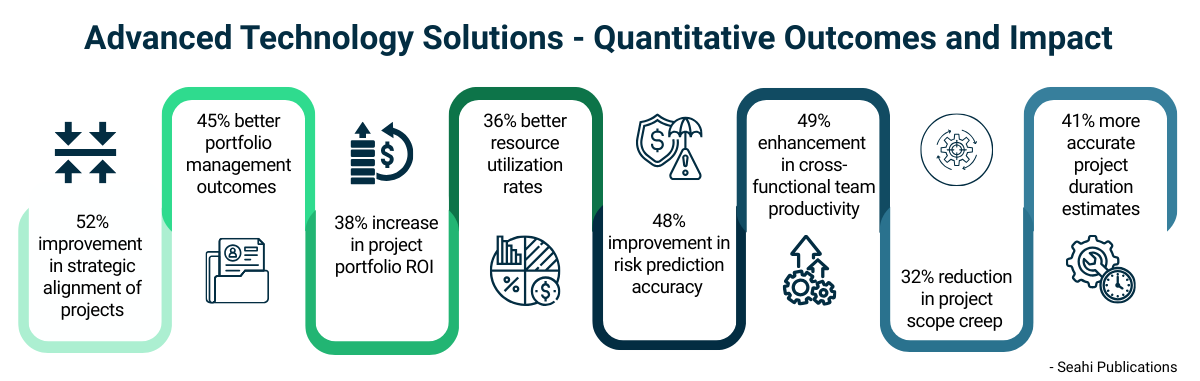
Translating metrics into executive language
Executives care about value creation—faster go-to-market, lower risk exposure, and higher client trust
Present dashboards in financial equivalents—days saved, cost avoided, capacity gained—to make ROI instantly visible to decision-makers
Visualization tools that work
Modern dashboards combine storytelling with predictive insight. They include:
- Heat maps highlighting projects trending “at-risk.”
- Forecast panels simulating how resource shifts affect delivery timelines
- Sentiment tiles translating stakeholder tone into engagement scores
These features close the loop between awareness and action—the foundation of predictive project intelligence
Future Trends in Advanced Technology Solutions for Predictive Project Management
The trajectory of advanced technology solutions in project management is clear—integration, autonomy, and continuous learning. The coming years will transform how teams plan, execute, and predict outcomes
Convergence of automation, analytics & AI
The future belongs to convergence
Hyper-automation will take over repetitive project management tasks such as reporting, resource balancing, and progress tracking. According to Harvard Business Review (2023), up to 80% of standard PM tasks could be automated by 2030
The next leap moves from predictive to prescriptive intelligence—solutions that not only forecast risks but recommend next-best actions, refining accuracy with every project
The predictive-intelligence multiplier
As data volumes multiply, the predictive layer becomes the differentiator
The collated global study shows that organizations using AI/ML for planning and resource allocation achieved:
This proves that foresight scales with maturity
Advanced predictive intelligence solutions like TrueProject embody this next frontier—ingesting data from multiple systems, interpreting sentiment, and surfacing early-warning insights that help executives act before issues escalate
Explore how predictive intelligence can evolve with your roadmap. Schedule a TrueProject strategy discussion to design your next-generation PM operating model.
Conclusion – How Advanced Technology Solutions Power Predictive Project Management
Project success today isn’t determined by how well you track—it’s defined by how early you see. Advanced technology solutions have evolved project management from oversight to insight, from status updates to strategic foresight. When automation, analytics, and cloud ecosystems work together, they create a living system of awareness that transforms every milestone into a measurable outcome
But foresight—not visibility—is now the defining edge. Predictive intelligence gives leaders the ability to act before issues escalate, align teams before risks multiply, and deliver outcomes before expectations shift. It’s no longer a competitive advantage—it’s a leadership imperative
That’s where TrueProject stands apart.
As the industry’s most reliable and relevant predictive intelligence solution for project management, TrueProject integrates seamlessly with your existing tools to surface early-risk indicators, interpret stakeholder sentiment, and provide actionable foresight you can trust. It doesn’t replace your systems—it makes them smarter
By turning hindsight into foresight and data into decisions, TrueProject transforms project management from reactive tracking to confident, predictive leadership—helping organizations deliver safer, smarter, and more successful outcomes, every time
Experience how TrueProject integrates with your advanced technology stack to surface unseen risks, interpret stakeholder sentiment, and enable faster, smarter delivery decisions—before issues escalate.
FAQs
1. What are advanced technology solutions in project management?
Advanced technology solutions are integrated digital ecosystems that combine AI, automation, analytics, and cloud platforms to plan, track, and optimize projects. They replace manual oversight with predictive, data-driven decisions that enhance speed, accuracy, and control
2. How do advanced technology solutions improve project success rates?
They cut delays, budget overruns, and coordination errors through automation and predictive insights. Research shows organizations using integrated digital ecosystems see 42% higher completion efficiency and 35% fewer resource conflicts
3. What’s the difference between automation and predictive intelligence in projects?
Automation performs routine tasks faster and consistently. Predictive intelligence analyzes data to forecast risks and recommend actions. Together, they move project management from reactive tracking to proactive control
4. How can project managers apply advanced technology solutions effectively?
- Define clear, measurable goals
- Use cloud-based platforms for unified visibility
- Automate repetitive workflows
- Add predictive analytics for foresight
- Measure and refine for continuous improvement
These steps build a scalable, insight-driven ecosystem
5. What future trends will shape advanced technology solutions in project management?
Key trends include AI-driven forecasting, IoT-based monitoring, blockchain for transparency, and digital-twin simulations. These innovations will make predictive intelligence central to modern project management